Thirteen
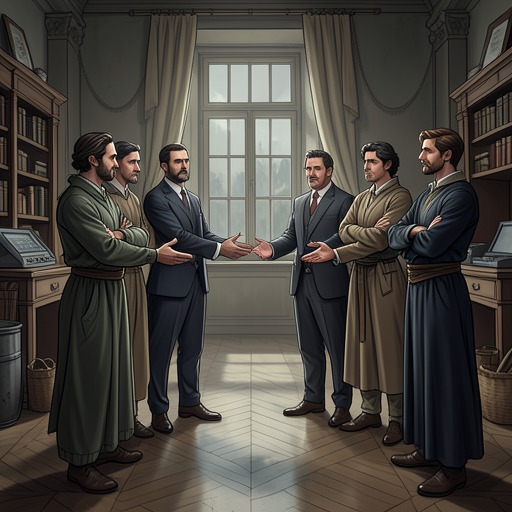
A Clash of KingsThe Thirteen is a powerful merchant faction in Qarth and one of the city’s principal centers of wealth and influence. Its members compete for dominance with the Ancient Guild of Spicers and the Tourmaline Brotherhood, while all three factions contend with the Pureborn and remain overshadowed by the feared warlocks. Through Xaro Xhoan Daxos, the faction becomes Daenerys Targaryen’s most substantial Qartheen connection, offering lavish hospitality and public attention without granting the military aid that would make her claim to the Iron Throne actionable.
Nature and Position
The Thirteen are merchant princes enriched by trade between the seas. Their power is not presented as a simple hierarchy but as part of a competitive political field: the Thirteen, the Ancient Guild of Spicers, and the Tourmaline Brotherhood each seek supremacy, and each struggles against the Pureborn. The faction therefore operates through wealth, rivalry, patronage, and access rather than through a single visible army or hereditary throne.
Their position also places them between commercial and formal authority. The Pureborn are descendants of the ancient kings and queens of Qarth and command the Civic Guard and the fleet of ornate galleys controlling the straits between the seas. The Thirteen lack that directly stated command, but their wealth allows them to shape whom Qarth notices, entertains, or receives. Their influence depends on turning commerce into political leverage, even while the Pureborn retain the institutional power Daenerys actually needs.
Patronage of Daenerys Targaryen
Xaro Xhoan Daxos, a member of the Thirteen, offers Daenerys hospitality on a scale that overwhelms her expectations. His palace is larger than many market towns and can supposedly house all her people and their horses. He gives an entire wing to her retinue, with gardens, a marble bathing pool, a scrying tower, a warlock’s maze, private green-marble chambers, silk hangings, and slaves to tend her needs. Xaro presents this extravagance as an appropriate gift to the Mother of Dragons, and the Thirteen are expected to come and pay homage to her.
The faction’s patronage extends beyond Xaro’s household. As rumors of living dragons spread through the east, he arranges for both the great and the humble to offer Daenerys tokens. The resulting stream of gifts becomes a flood: merchants bring lace from Myr, saffron from Yi Ti, amber and dragonglass from Asshai, and bags of coin; silversmiths bring rings and chains; performers entertain her; a pair of Jogos Nhai present a fierce striped zorse; and the Tourmaline Brotherhood gives her a crown shaped like a three-headed dragon. Xaro’s generosity and quick wits also help finance the bribes required to gain access to the Pureborn’s Hall of a Thousand Thrones.
This generosity is politically useful but deliberately ambiguous. Xaro offers comfort, spectacle, and social introduction, while Daenerys wants ships and swords to reclaim the red castle at King's Landing. He can make Qarth’s elite look toward her, but he cannot make that attention become an army. The Thirteen’s interest is therefore tied to the dragons as wonders and sources of prestige, not necessarily to Daenerys as a claimant whose war must be materially supported.
Refusal of Military Aid
Daenerys approaches the Pureborn because their faction controls the fleet and soldiers she needs. To reach them, she follows Qartheen custom: she makes the traditional sacrifice in the Temple of Memory, bribes the Keeper of the Long List, sends the traditional persimmon to the Opener of the Door, and receives the blue silk slippers summoning her to the Hall of a Thousand Thrones. The elaborate procedure grants her an audience, but not assistance.
The Pureborn listen from monumental ancestral seats in a hall decorated with goldwork, amber, onyx, lapis, and jade, yet their grandeur contrasts with their indifference. Daenerys concludes that they have come from curiosity and boredom, with the dragon on her shoulder holding more interest for them than the queen herself. The Thirteen are implicated in this wider Qartheen failure: despite the faction’s wealth and Xaro’s ability to open doors, no ships or soldiers are provided for her campaign.
Daenerys is left regretting the money spent on bribes to Mathos Mallarawan, Wendello Qar Deeth, and Egon Emeros the Exquisite, since the same resources might have bought a ship or hired twenty sellswords. Xaro warns her that extracting gold from the Pureborn is nearly impossible and invokes the Sorrowful Men, an ancient guild of assassins, to illustrate the danger of pressing the matter. His warning exposes the limits of merchant protection: he can mediate, flatter, and generate gifts, but the faction cannot compel Qarth’s rival powers to turn fascination into loyalty.
Reversal and Decline of Support
The Thirteen’s attitude changes after the House of the Undying collapses in smoke and flame. Qarth’s people remember overnight that dragons are dangerous, and the faction’s earlier competition to honor Daenerys gives way to hostility. The Tourmaline Brotherhood openly calls for her expulsion, while the Ancient Guild of Spicers calls for her death; the Thirteen do not immediately join them only because Xaro struggles to keep the faction from doing so.
This reversal makes the Thirteen’s political logic clear. Its support is contingent, responsive to perceived advantage, and vulnerable to fear. While Daenerys and her dragons promise distinction, gifts, and commercial attention, the faction can present itself as a generous host. Once the dragons become a threat to Qartheen security and the balance among the city’s factions, the same relationship turns into a liability. The Thirteen’s interest follows the changing value of proximity to Daenerys rather than any durable commitment to her bloodline or cause.
Political Significance
The Thirteen embody Qarth’s marketplace politics, where magnificence, ceremony, and generosity can coexist with refusal. Their patronage gives Daenerys shelter and visibility, and Xaro’s intervention helps her reach the city’s highest political audience. Yet the faction does not supply the essential instruments of conquest. Its wealth can surround a claimant with silk, jewels, performers, exotic goods, and a crown shaped like a three-headed dragon, but it cannot by itself create the fleet and soldiers required to take the Iron Throne.
Their story also contrasts commercial power with other forms of legitimacy in the wider war. Stannis Baratheon states his claim through birth, blood, and a formal declaration against the children of Cersei Lannister and Jaime Lannister; Renly Baratheon answers that Robert Baratheon won the throne with his warhammer and treats military success as the practical foundation of a claim. In Qarth, the Thirteen offer neither inherited sovereignty nor decisive force. They offer access, spectacle, and temporary protection, demonstrating how quickly a political alliance founded on advantage can become exclusion when the balance of fear changes.